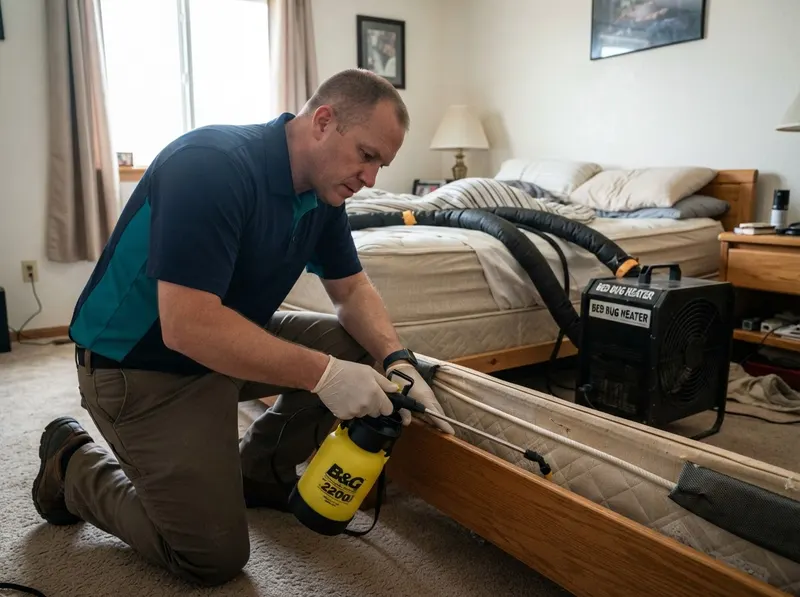
Thermal heat eradication relies on industrial forced-air heaters elevating ambient room temperatures to lethal thresholds between 122°F and 135°F. This thermal zone penetrates deep into dense mattresses, wall cavities, and subflooring to denature bed bug proteins and desiccate eggs within 90 minutes of contact. In contrast, targeted chemical eradication utilizes dual-action residual insecticides and insect growth regulators (IGRs) placed inside cracks, furniture joints, and baseboard perimeters. A purely chemical approach requires 2 to 3 follow-up visits spaced 14 days apart to intercept newly hatched nymphs. A hybrid protocol uses chemical perimeter bands as an escape barrier while heat penetrates the core living areas.
Selecting between thermal convection and chemical treatment depends on the structure and infestation severity. In historic frame homes in Old Colorado City or multi-level ranches near Cheyenne Mountain, high-volume clutter or unsealed wood flooring can create thermal cold spots below 120°F. In those zones, chemical liquid barriers prevent escaping bed bugs from migrating into adjoining wall voids. For modern, tightly insulated builds in Briargate, Flying Horse, or Stetson Hills, whole-structure thermal remediation resolves severe infestations in a single 8-hour workday without requiring residents to discard high-end furniture. The operational trade-off centers on preparation intensity versus timeline: thermal treatments require removing heat-sensitive items such as candles, aerosol cans, and vinyl blinds prior to heating, while chemical programs require minimal initial deconstruction but extend eradication across multiple hatching cycles.
Altitude and regional temperature differentials in Colorado Springs alter thermal remediation physics. At elevations between 6,035 feet in central downtown and 7,200 feet near Peregrine and Rockrimmon, thinner atmospheric pressure requires higher convective air volumes to maintain uniform core temperatures inside interior walls. Winter conditions near the base of Pikes Peak cause rapid perimeter cooling along north-facing exterior walls, necessitating targeted infrared thermography during the heat soak. Zelvaro Bug Defense deploys real-time wireless thermal sensors throughout the structure to monitor interior cavity temperatures, ensuring structural cold zones never compromise eradication thresholds.