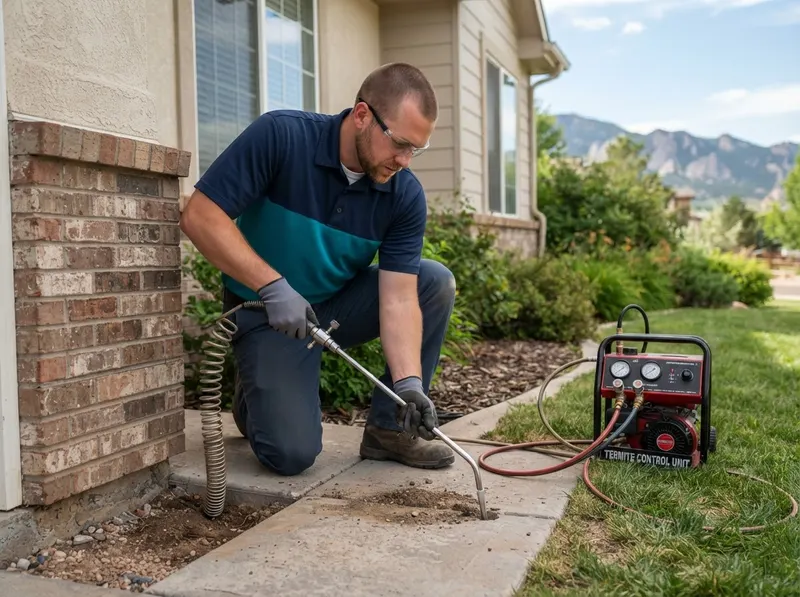
Subterranean termite treatment in Colorado Springs requires methods matched to local geology and freeze-thaw soil movement. In hillside neighborhoods like Peregrine, Rockrimmon, and Cheyenne Mountain, structures sit on fractured sandstone or steep granite embankments where termites enter through utility penetrations or seismic expansion gaps. Liquid termiticide trenching establishes a continuous chemical treated zone 6 inches wide and 6 inches deep around exterior stem walls, forcing workers to track fipronil back to the primary colony queen beneath the 30-inch winter frost line.
Older residences in Old Colorado City and Broadmoor frequently feature stacked-stone foundations or dirt crawlspaces, while newer construction in Briargate, Stetson Hills, and Flying Horse utilizes continuous poured-concrete basement slabs. When soil-to-wood contact occurs near porch footers or lower siding runs, liquid perimeter barriers offer immediate exclusionary protection. In areas bordering native pine scrub near Palmer Park and Red Rock Canyon Open Space where bedrock prevents uniform digging, low-profile bait stations placed at 10-foot intervals intercept foraging worker termites without concrete drilling or landscape excavation.
Selecting between bait matrix networks and liquid soil barriers involves clear structural considerations. Liquid applications provide immediate mechanical protection across foundation walls but require drilling through patio slabs every 12 inches to reach footer soil. Bait systems bypass concrete drilling and preserve finished basements, yet rely on worker feeding cycles that take 60 to 90 days to achieve total colony elimination. Step-by-step implementation follows three phases: first, an acoustic and probe evaluation of interior baseboards and joist bands; second, continuous perimeter soil treatment using calibrated sub-surface injection rods; third, annual physical monitoring of external stations to measure cellulose consumption rates.